


Propeller shaft misalignment represents one of the most insidious problems that can compromise the efficiency and reliability of a vessel. This phenomenon, often underestimated in its early stages, can escalate rapidly, causing significant damage to the entire propulsion system. Timely recognition of the signs of an improperly aligned shaft allows for intervention before costly breakdowns or dangerous situations occur during navigation. The symptoms of propeller shaft misalignment manifest through specific indicators that every owner, captain, or naval technician should be able to interpret carefully.
Abnormal Vibrations: The First Warning Sign
Vibrations represent the most evident and immediate symptom of propeller shaft misalignment. When the shaft line is not perfectly aligned with the propulsion unit, oscillations are generated and transmitted through the entire structure of the vessel. These vibrations are clearly distinguishable from normal operational oscillations by their intensity, frequency, and peculiar characteristics.
A correctly aligned shaft transmits rotational motion smoothly and uniformly, whereas even minimal misalignment creates cyclic stresses that increase proportionally with the rotation speed. Vibrations can be felt at the helm, on the deck, through the hull, and even in living spaces. In some cases, unsecured objects begin to move or resonate at certain speeds, indicating resonance frequencies induced by the misalignment.

Types of Vibrations and Their Meaning
Vibrations caused by propeller shaft misalignment symptoms manifest in various forms, each indicative of specific conditions. Axial vibrations, which propagate along the longitudinal axis of the vessel, generally indicate angular misalignment. Radial vibrations, perceivable perpendicular to the shaft, suggest parallel or eccentric misalignment.
A particularly significant aspect concerns the correlation between vibrations and rotation speed. If oscillations increase linearly with propeller RPM, the misalignment is likely static in nature. Conversely, when vibrations peak at specific speeds and then decrease, resonance phenomena are present, amplifying the effects of the misalignment. According to Seiffert Industrial, these excessive vibrations constitute one of the most reliable diagnostic signals for identifying alignment problems.
Excessive Noise and Acoustic Anomalies
The second distinctive symptom of propeller shaft misalignment manifests through abnormal noises coming from the propulsion unit. A correctly aligned system produces a constant and uniform hum, while a misaligned shaft generates characteristic sounds easily identifiable by expert ears.
The most common noises include metallic knocking, squeaking, whistling, and intermittent humming that vary with the rotation speed. These sounds result from abnormal contact between components that should not be in direct contact or from excessive stress on bearings, bushings, and supports. Particularly concerning is the sound of continuous rubbing, which indicates constant contact between metal surfaces resulting in material removal.
Locating the Sound Source
Precisely identifying the source of the noise helps determine the type and extent of the misalignment. Noises coming from the coupling joint area suggest misalignment between the engine and the shaft, while sounds originating near the stuffing box indicate possible alignment issues between the shaft and the propeller. The intermediate bearing area, when present, can produce characteristic noises if subjected to excessive radial loads due to misalignment.
Acoustic intensity also provides indications of the severity of the situation. Noises barely perceptible at high speeds may indicate minimal misalignment, while loud sounds audible even at low RPM signal critical conditions requiring immediate intervention. Preventive maintenance of the propeller shaft should always include a systematic acoustic analysis during various operating conditions.
Premature Component Wear
The third fundamental symptom of propeller shaft misalignment manifests through abnormal wear patterns on various components of the propulsion system. A misaligned shaft generates asymmetrical loads and concentrated stresses that drastically accelerate the deterioration of mechanical parts.
| Component | Normal Wear | Wear from Misalignment |
|---|---|---|
| Bushings | 2000-3000 hours | 300-600 hours |
| Couplings | 4000-6000 hours | 800-1500 hours |
| Stuffing Box | 1500-2500 hours | 200-400 hours |

The stuffing box bushings show evident signs when the shaft is not correctly aligned. Instead of uniform wear around the entire circumference, areas with significantly higher material removal are observed, often accompanied by deep scoring and discoloration due to overheating. The stuffing box itself may exhibit excessive leakage, requiring frequent adjustments and premature replacement of the seals.
Analysis of Wear Patterns
Carefully examining components during maintenance operations provides valuable information on the state of alignment. Wear concentrated on one side of the bearing indicates angular misalignment, while uniform but accelerated wear suggests parallel misalignment with high radial loads. The traces left by the components reveal the mechanical history of the system and allow for the diagnosis of problems before complete failure.
As highlighted by best practices for alignment maintenance, regular checks and systematic documentation of wear patterns allow for the identification of trends and the prevention of catastrophic failures. The inspection should include dimensional measurements, visual evaluation of surfaces, and lubricant analysis to detect metal particles indicative of abnormal wear.
Increased Consumption and Loss of Efficiency
An often overlooked but economically significant symptom of propeller shaft misalignment concerns the increase in fuel consumption and the reduction of propulsive efficiency. When the shaft is not perfectly aligned, a significant portion of the energy generated by the engine is dissipated in parasitic friction, vibrations, and elastic deformations instead of being converted into propulsive thrust.
Misalignment creates additional resistance in the transmission system that the engine must compensate for by increasing the torque delivered. This translates into higher fuel consumption at the same speed compared to a correctly aligned system. In some cases, the increase in consumption can reach 15-20%, representing a significant operating cost, especially for commercial vessels or yachts with intensive use.
Measuring Efficiency Loss
Quantifying the loss of efficiency requires comparative measurements between different operating conditions. Systematically recording consumption at standardized speeds allows for the identification of deviations from reference values. A gradual increase in consumption without changes in operating conditions or the state of the hull suggests progressive alignment problems.
The maximum reachable speed represents another reliable indicator. A misaligned shaft limits the propulsion system’s ability to transmit power efficiently, resulting in lower top speeds compared to nominal performance. This performance reduction is often accompanied by difficulty in reaching certain cruising speeds or accelerating rapidly.
Steering System and Maneuverability Issues
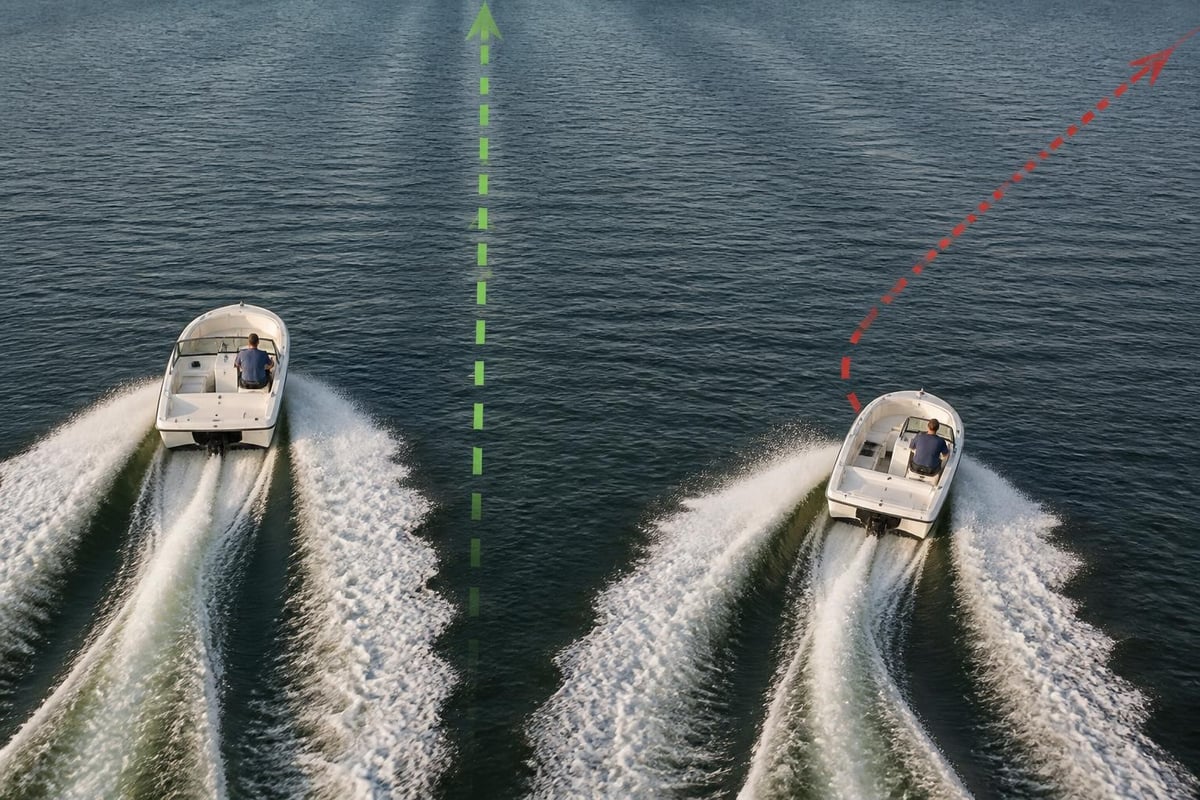
Propeller shaft misalignment symptoms also include alterations in rudder response and the general maneuverability of the vessel. An improperly aligned shaft generates asymmetrical lateral forces that influence trajectory and directional stability, particularly evident at certain speeds.
The vessel may show a tendency to veer to one side, requiring continuous rudder corrections to maintain course. This phenomenon, known as “rudder pull,” increases the helmsman’s workload and consumes additional energy to counteract the lateral forces induced by the misalignment. During port maneuvers, the response to commands is less predictable and precise compared to a correctly aligned system.
Effects on Course Stability
Directional stability is compromised when the shaft transmits thrust that is not perfectly aligned with the longitudinal axis of the vessel. This creates twisting moments that must be continuously compensated for by the steering system. In heavy sea conditions, these effects are amplified, making it more difficult to maintain the desired course.
The situation is particularly critical during gear reversals. A misaligned shaft can cause violent vibrations in reverse or abnormal behavior that makes port maneuvers risky. Professional propeller shaft alignment eliminates these problems by restoring the correct geometry of the propulsion system.
Overheating of Mechanical Components
Abnormal temperature rise represents an important diagnostic symptom of misalignment. Excessive friction generated by an unaligned shaft produces heat that accumulates in bearings, bushings, and coupling joints. This overheating accelerates lubricant degradation, reduces operating tolerances, and can lead to sudden seizures.
Bearings operating under misalignment conditions develop temperatures significantly higher than nominal values. Surface temperatures exceeding 70-80°C indicate abnormal loads or insufficient lubrication, both typical consequences of misalignment. In extreme cases, overheating can cause partial melting of the bushing material or thermal degradation of the seals.
Preventive Thermal Monitoring
Implementing a thermal monitoring system allows for the early identification of misalignment conditions before they cause irreversible damage. Infrared thermal cameras or permanently installed temperature sensors provide continuous data on the thermal state of critical components. Abnormal thermal patterns, such as localized hot spots or excessive temperature gradients, signal the need for in-depth alignment checks.
The temperature of the stuffing box deserves particular attention. An increase in temperature in this area, accompanied by water leaks or smoke emission, indicates excessive friction between the shaft and the bushings due to misalignment. According to Magellano Store, seasonal checks should always include thermal verifications to promptly identify anomalies.
Water Leaks and Stuffing Box Problems
The stuffing box system undergoes particularly severe stress in the presence of propeller shaft misalignment. A shaft that oscillates or vibrates excessively compromises the seal integrity, causing water infiltration into the bilge that can range from minimal dripping to concerning flows. These leaks not only require frequent adjustment interventions but also indicate abnormal operating conditions that are damaging the system.
A correctly sized and installed stuffing box on an aligned shaft maintains its seal with minimal leakage for dozens of operating hours. Conversely, when the shaft is misaligned, lateral movement and vibrations prevent the seals from maintaining the uniform contact necessary for an effective seal. The need to frequently tighten the stuffing box to reduce leaks creates further problems, increasing friction and overheating.
Leakage Diagnostics
Analyzing the characteristics of water leaks provides useful indications of the nature of the problem. Intermittent leaks that vary with speed suggest shaft vibrations due to misalignment. Constant and progressive leaks indicate seal wear accelerated by abnormal shaft movements. In some cases, steam emission from the stuffing box is observed, an unequivocal sign of overheating caused by excessive friction.
Visual inspection of the stuffing box during maintenance operations reveals evident signs of alignment problems. Circumferential scoring on the shaft, asymmetrical bushing wear, and seal deformation indicate that the shaft is not rotating concentrically with respect to the stern tube. The correlation between these signs and other symptoms of misalignment confirms the diagnosis and guides the necessary corrective actions.
Structural Damage to the Hull and Supports
In the most severe and prolonged cases, propeller shaft misalignment symptoms extend beyond mechanical components, involving the structure of the hull itself. Chronic vibrations transmitted through the shaft supports can cause cracks in the fiberglass, loosening of fastening bolts, and deterioration of structural reinforcement areas. These issues, if not addressed promptly, compromise the structural integrity of the vessel.
Intermediate shaft supports, when present, undergo particularly intense stress in misalignment conditions. The foundations of these supports can develop cracks, elastic joints can degrade prematurely, and fastening systems can progressively loosen. This structural damage requires complex and costly repair interventions that far exceed the cost of correct preventive alignment.
Verification Methodologies and Professional Diagnosis
Definitively confirming the presence and quantifying the extent of misalignment requires specialized instrumentation and advanced technical skills. Professional measurements use dial indicators, laser systems, and digital tools that provide precise data on all geometric parameters of the shaft. These surveys allow for the distinction between angular, parallel, or combined misalignment and the determination of the necessary corrections.
| Verification Method | Precision | Application | Time Required |
|---|---|---|---|
| Analog dial indicators | ±0.05mm | Periodic checks | 2-3 hours |
| Laser systems | ±0.01mm | Critical alignments | 1-2 hours |
| Digital tools | ±0.02mm | Standard checks | 1.5-2.5 hours |
| Vibration analysis | Qualitative | Preliminary diagnosis | 0.5-1 hour |
Professional verification begins with a preliminary analysis of operating conditions and reported symptoms. Subsequently, measurements are taken with the vessel in the water and under normal load conditions, as real operating conditions can differ significantly from those at the dock. Specialists verify alignment at multiple points along the shaft and under different rotation conditions to identify even dynamic misalignments that manifest only during operation.
Specialized Corrective Interventions
Once misalignment is diagnosed, corrective interventions must be performed with millimeter precision using appropriate techniques and tools. Corrections may include adjusting engine mounts, modifying intermediate shaft supports, rectifying coupling surfaces, or, in more complex cases, replacing deformed or damaged components. Every intervention must be followed by instrumental verifications to confirm the restoration of optimal conditions.
For high-end vessels such as yachts and superyachts, professional alignment represents an essential investment to preserve the performance and value of the unit. Specialized services such as yacht propeller maintenance include systematic alignment checks as an integral part of preventive maintenance programs. Complete documentation of every intervention provides valuable historical traceability for vessel management.
Prevention and Scheduled Maintenance
Preventing misalignment is significantly more economical than repairing the resulting damage. A structured maintenance program should include periodic alignment checks based on operating hours, type of use, and operating conditions. Sport boats subjected to intense stress require more frequent checks than moderately used cruising units.
Storage and launching operations represent critical moments during which misalignment can occur or worsen. The supports used during storage must distribute the hull’s weight uniformly to avoid deformations that alter the shaft line geometry. After launching, an instrumental alignment check confirms that no shifts occurred during handling operations.
In addition to scheduled periodic checks, any abnormal event should prompt an extraordinary verification. Groundings, collisions, replacements of shaft line components such as the propeller or coupling, and sudden vibrations require an immediate alignment check. Promptly addressing even small misalignments prevents escalation toward major and costly damage.
The coupling systems between the engine and shaft deserve particular attention in preventive maintenance. The keyed propeller coupling must be checked regularly to ensure that no play or wear has developed that could contribute to the overall misalignment of the system. Correct installation and maintenance of all interface components guarantee the integrity of the shaft line over time.
Timely recognition of propeller shaft misalignment symptoms allows for intervention before irreversible damage occurs to the entire propulsion system, preserving operational efficiency and reducing maintenance costs. The combination of careful monitoring, periodic instrumental checks, and professional corrective interventions ensures optimal performance and long component life. Koreax offers specialized propeller shaft alignment services with precision digital instrumentation and advanced mobile workshops, operating throughout the Mediterranean basin to support owners, shipyards, and nautical operators with high-level technical expertise and cutting-edge operational solutions.


